

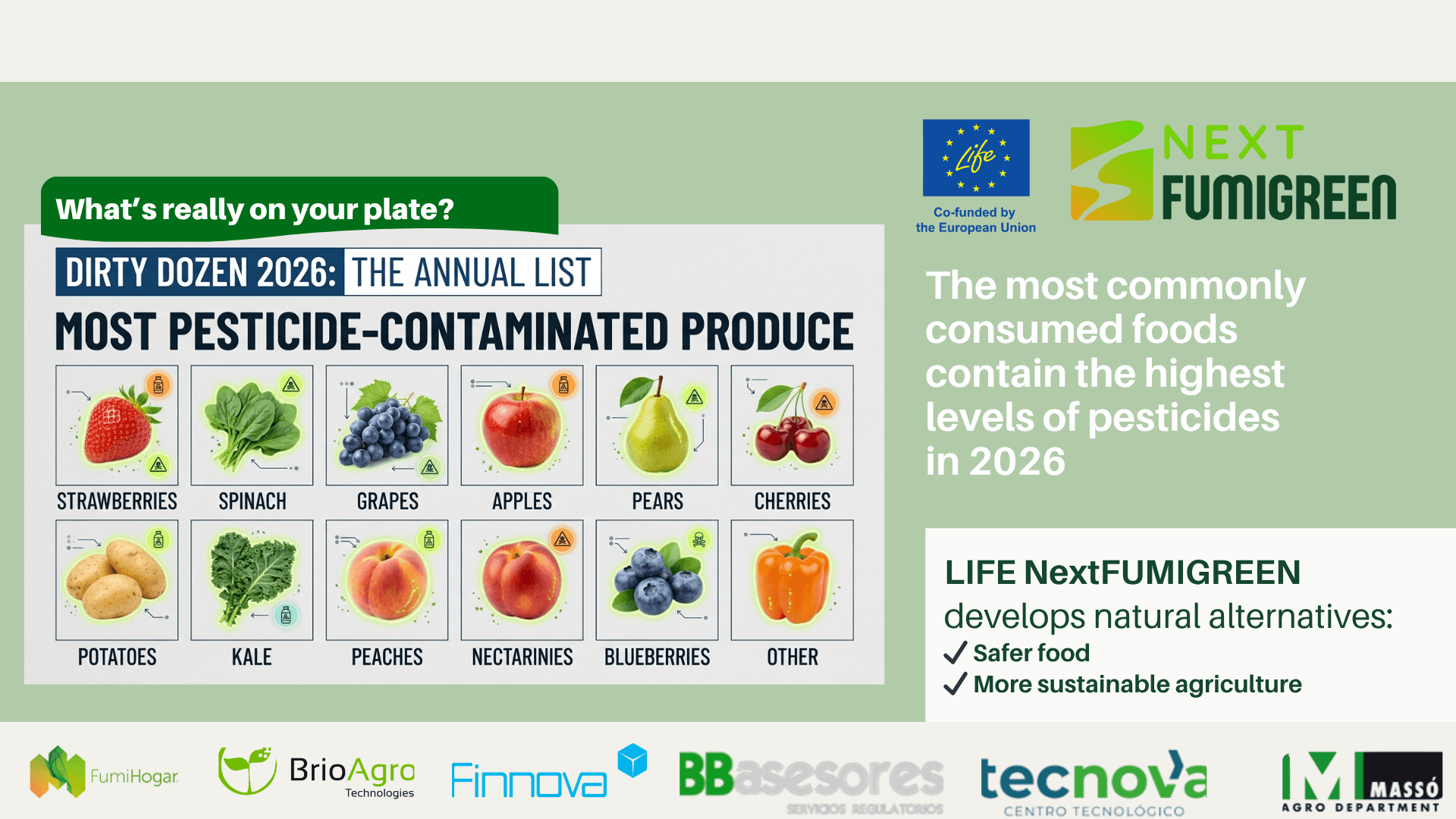
· Blueberries, spinach, strawberries, and grapes top the list of products with the highest pesticide residue levels in 2026
· The international study reveals the continuous exposure of consumers to potentially toxic substances
· LIFE NextFUMIGREEN promotes natural alternatives to reduce the use of chemicals in agriculture
· Finnova strengthens innovation transfer and European cooperation towards safer food systems
Brussels, April 20, 2026. The international study published on March 26 by the Environmental Working Group (EWG) identifies the foods with the highest pesticide residue levels in 2026, placing commonly consumed products such as blueberries, spinach, strawberries, grapes, and apples at the top of the list. In this context, the European project LIFE NextFUMIGREEN highlights the need to transform the current agricultural model through sustainable solutions that reduce dependence on chemical products and improve food safety. The report, based on data from institutions such as the USDA and the FDA, analyzes pesticide residues in fruits and vegetables consumed globally, warning of risks to human health and the environment.
Foods with the highest pesticide presence: a growing concern
The report identifies the well-known “Dirty Dozen 2026” list, which groups the 12 foods with the highest pesticide contamination. These include:
· Blueberries
· Spinach
· Strawberries
· Grapes
· Apples
· Pears
· Peaches and nectarines
· Cherries
· Kale and leafy greens
· Potatoes
These products contain residues of multiple pesticides, some of which are associated with potential health risks such as carcinogenic effects or endocrine disruption. The study also points out that, in many cases, these residues remain even after washing or peeling, increasing long-term consumer exposure.
Impact on health and the environment
The continuous presence of pesticides in food poses a dual challenge:
On one hand, it directly affects human health by increasing exposure to potentially toxic chemical substances. On the other, it has a significantenvironmental impact, contributing to soil degradation, water pollution, and biodiversity loss.
This context reinforces the need to move towards more sustainable agricultural models, aligned with European strategies such as the European Green Deal and the “Farm to Fork” strategy.
LIFE NextFUMIGREEN: innovation to reduce pesticides
In response to this scenario, the European project LIFE NextFUMIGREEN positions itself as an innovative solution aimed at reducing the use of conventionalpesticides. The project develops natural fumigants derived from plant extracts to control pests and diseases in intensive horticultural crops, offering a lesstoxic and more environmentally friendly alternative.
This approach enables:
· Reduction of chemical residues in food
· Improvement of soil health and agricultural ecosystems
· Decreased dependence on external chemical inputs
· Progress towards safer and more sustainable agriculture
Finnova’s role in the agricultural transition
The Finnova Foundation plays a key role in dissemination, knowledge transfer, and the attraction of European funding for innovative projects such as LIFE NextFUMIGREEN.
Through its international collaboration network, Finnova connects innovation, sustainability, and European policies, promoting scalable solutions thatcontribute to improving global food safety.
Towards safer food systems
The results of the 2026 study highlight the urgency of accelerating the transition towards more sustainable agricultural models. The combination of scientificevidence and innovative solutions, such as those developed within LIFE NextFUMIGREEN, demonstrates that it is possible to reduce pesticide levels in foodwithout compromising agricultural productivity.
The project, led by FumiHogar and developed in collaboration with Fundación Tecnova, Fundación Finnova, B&B Asesores, Comercial Química Massó, and BrioAgro Tech, represents an example of European cooperation aimed at improving food safety, protecting human health, and preserving the environment, with a total budget of €2,758,921.01, co-funded at 60% by the LIFE Programme.
More information: https://lifefumigreen.finnova.eu/