

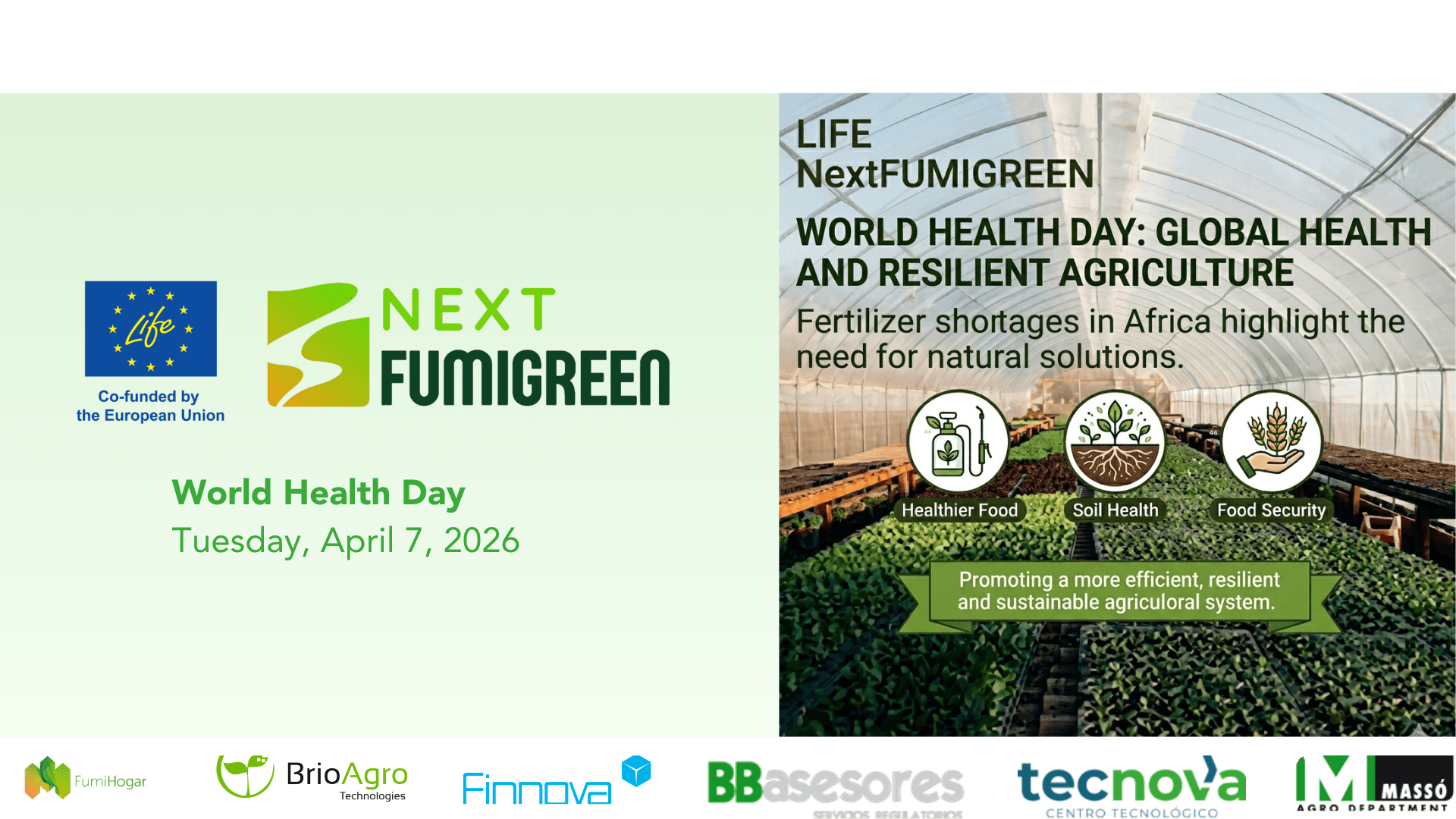
• The European project highlights the link between health, agriculture, and sustainability on World Health Day
• Fertilizer shortages, exacerbated by the war in Iran, threaten agricultural production in Africa
• LIFE NextFUMIGREEN develops natural alternatives to strengthen food security
Brussels, April 7, 2026. On the occasion of World Health Day, the European project LIFE NextFUMIGREEN highlights the direct connection between global health, sustainability, and food security, in a context marked by the growing risk of a food crisis in Africa. The disruption of fertilizer supply, driven by international geopolitical tensions, is affecting agricultural productivity and underscores the urgent need to promote innovative solutions that ensure resilient food systems.
Global health and food crisis: an urgent challenge
World Health Day underscores that human well-being largely depends on access to safe and sufficient food. In this context, Africa is facing a critical situation caused by fertilizer shortages, a key input for agricultural production.
As international organizations warn, disruptions in key supply routes, such as the Strait of Hormuz, are limiting access to raw materials needed for fertilizer production, increasing costs by up to 50% and particularly affecting regions with high import dependency.
This situation compromises farmers’ productive capacity and increases the risk of food insecurity, potentially affecting millions of people across different regions of the African continent.
Fertilizer dependency and vulnerability of the agricultural system
The current agricultural model shows a high dependency on imported chemical fertilizers, making it especially vulnerable to international crises. In regions such as Sub-Saharan Africa, where up to 90% of fertilizers are imported, any disruption in supply has an immediate impact on crops and food availability.
In addition to rising input costs, this situation limits access to fertilizers for small-scale farmers, directly affecting crop yields and the stability of food systems.
LIFE NextFUMIGREEN: innovation serving health and sustainability
In this context, LIFE NextFUMIGREEN positions itself as a key initiative to advance more sustainable and resilient agricultural models. The project develops natural fumigants derived from plant extracts to control pests in intensive horticultural crops, reducing the need for conventional chemical products and improving soil health.
This approach helps strengthen food security by promoting more efficient, sustainable agricultural practices that are less dependent on external inputs, in line with the objectives of the European Green Deal.
Sustainable agriculture as a pillar of global health
The innovation driven by LIFE NextFUMIGREEN addresses three fundamental dimensions in an integrated way:
Human health, by reducing chemical residues in food
Environmental health, by protecting soil and natural resources
Food security, by ensuring the continuity of agricultural production
This model demonstrates that the transition towards nature-based solutions is not only environmentally necessary, but also strategically essential to address global crises such as the current fertilizer shortage.
The experience of LIFE NextFUMIGREEN, led by FumiHogar and developed in collaboration with a consortium composed of Fundación Tecnova, Fundación Finnova, B&B Asesores, Comercial Química Massó, and BrioAgro Tech, highlights the key role of European innovation in building more sustainable, resilient agricultural systems aligned with the protection of global health. With a total budget of €2,758,921.01, co-funded at 60% by the LIFE Programme, the project actively contributes to reducing dependency on external inputs and promoting scalable solutions at international level.
More information: https://fumihogar.es/life-nextfumigreen/